After a training build disrupted by injuries and an ankle problem in the final weeks, Alicia arrived in Cervia for her first Ironman with one overriding objective: get to the finish line.
What followed was a dream swim, a controlled bike leg and a marathon that became a very different challenge when stomach problems made taking on nutrition increasingly difficult.
This is Alicia’s IRONMAN Italy race report — including her experience of the swim, bike and run courses, race-day organisation, travel and logistics, nutrition, and what she’d do differently next time.
IRONMAN Italy Race Details
Alicia’s race-day goal was simple: “Don’t drown, crash or fall.”
Getting to IRONMAN Italy & Where to Stay
Alicia travelled to Italy with her mum and a friend who had come along to support her. They stayed in an Airbnb around a 30-minute walk from transition.
The accommodation helped keep the trip within budget, although Alicia felt that one of the many hotels along Cervia’s seafront would have been more convenient for race morning.
She flew into Bologna Airport and then travelled to Cervia by train. The journey itself was straightforward, although trains from Bologna Centrale to Cervia were only around once per hour, making some waiting around likely depending on flight times.
There was also an unexpected complication: Alicia arrived in Italy before her bike.
The bike box remained at Heathrow for another flight or two, creating exactly the kind of stress an athlete doesn’t need immediately before an Ironman.
Alicia had booked the Nirvana Experience because standard race entries had already sold out. In this situation, having somebody she could contact while travelling from the airport — including asking about the possibility of a hire bike if hers didn’t arrive — proved particularly useful.
The package also included race-morning transport to transition, transport around the event, a bike check and somebody available to answer practical questions.
Registration & Pre-Race Organisation
Alicia arrived on Thursday ahead of Saturday’s race, which gave her enough time to register, explore the event area and get everything organised without rushing.
Registration itself was straightforward and the expo wasn’t particularly busy on Thursday.
The pre-race information was generally good, although the exact swim-start location wasn’t immediately obvious. Arriving early enough to explore therefore proved useful.
The atmosphere built as race day approached. Thursday was relatively relaxed, while Friday brought more of the traditional Ironman pre-race buzz, including music around the expo.
Alicia found the volunteers friendly and helpful and felt that the local community genuinely supported the event.
The Nirvana pre-race briefing also provided some useful practical information and an opportunity to meet other athletes, check bikes and settle some of the inevitable pre-race nerves.
Training for Alicia’s First Ironman
Alicia felt very fit going into the race, although, like many athletes before their first Ironman, she still felt as though another week of preparation would have been useful.
Her route to the start line hadn’t been completely straightforward. A combination of old injuries and new niggles meant training became a balancing act between accumulating enough volume and avoiding further aggravation.
The biggest uncertainty surrounded the marathon.
An ankle problem appeared during the final six weeks of training and Alicia’s longest run before the race was only a little over two hours. She had also never previously run a marathon.
Although completing the race was always the primary objective, she admits that a finish somewhere around 12 hours had been sitting in the back of her mind before the ankle problem forced her to loosen that expectation.
Key Training Sessions
Long bike rides were particularly valuable because they provided repeated opportunities to practise race nutrition — including making mistakes and gradually establishing what worked.
Bike interval sessions presented a different challenge. Living in London made finding uninterrupted roads difficult, so one useful adjustment was realising that longer sessions didn’t necessarily require one continuous interval.
Breaking the work into shorter efforts while accumulating the required time in the appropriate training zone made those sessions much easier to execute effectively.
Alicia also completed several one-to-one swimming lessons, which she felt completely transformed her swimming and significantly improved her confidence ahead of race day.
IRONMAN Italy Race Morning
Race morning started at 4:30am.
Alicia ate a bagel, although nerves made finishing it difficult, and sipped a bottle of carbohydrate drink because she was expecting some pre-race nausea.
She didn’t complete much of a formal warm-up. After seeding herself somewhere around the middle of the swim field, she went for a quick dip to settle the wetsuit before relying mainly on nervous jumping and arm swings while waiting for the start.
Despite preparing everything the night before — including taking photos so she could reassure herself that everything was where it should be — there was still the familiar pre-Ironman feeling that something must have been forgotten.
Once the bike was ready and the wetsuit was on, things became calmer. Alicia knew how much work she’d put into her swimming and open-water confidence and was ready to get into the sea and start racing.
IRONMAN Italy Swim Course
For Alicia, the swim was a dream.
There had been some uncertainty early in the morning about whether wetsuits would be permitted. The sea temperature was eventually announced as 24.3°C, meaning the race was wetsuit legal.
Conditions were generally good. There was some chop and swell but no significant waves, and visibility in the water was very good.
Congestion was manageable for most of the swim, becoming slightly more physical only around the final turn towards the beach and T1.
Alicia found the one-loop course straightforward to navigate, particularly for athletes confident in sighting for themselves. Predominantly straight sections made it possible to hold a good line and avoid swimmers taking a less accurate route.
There were a few jellyfish, although not many, and any stings Alicia experienced were mild.
There also appeared to be plenty of paddleboards and boats available for athletes needing assistance.
Her only significant criticism concerned the start procedure. Athletes self-seeded into corrals separated by metal barriers and were gradually released through one or two gates.
Alicia felt a conventional snake-style queue might have flowed better, as the intended pace groups became fairly mixed before athletes actually entered the water.
T1: Swim to Bike
T1 was smooth and straightforward, although it is a relatively long transition with a fair distance to cover before getting onto the bike.
IRONMAN Italy Bike Course
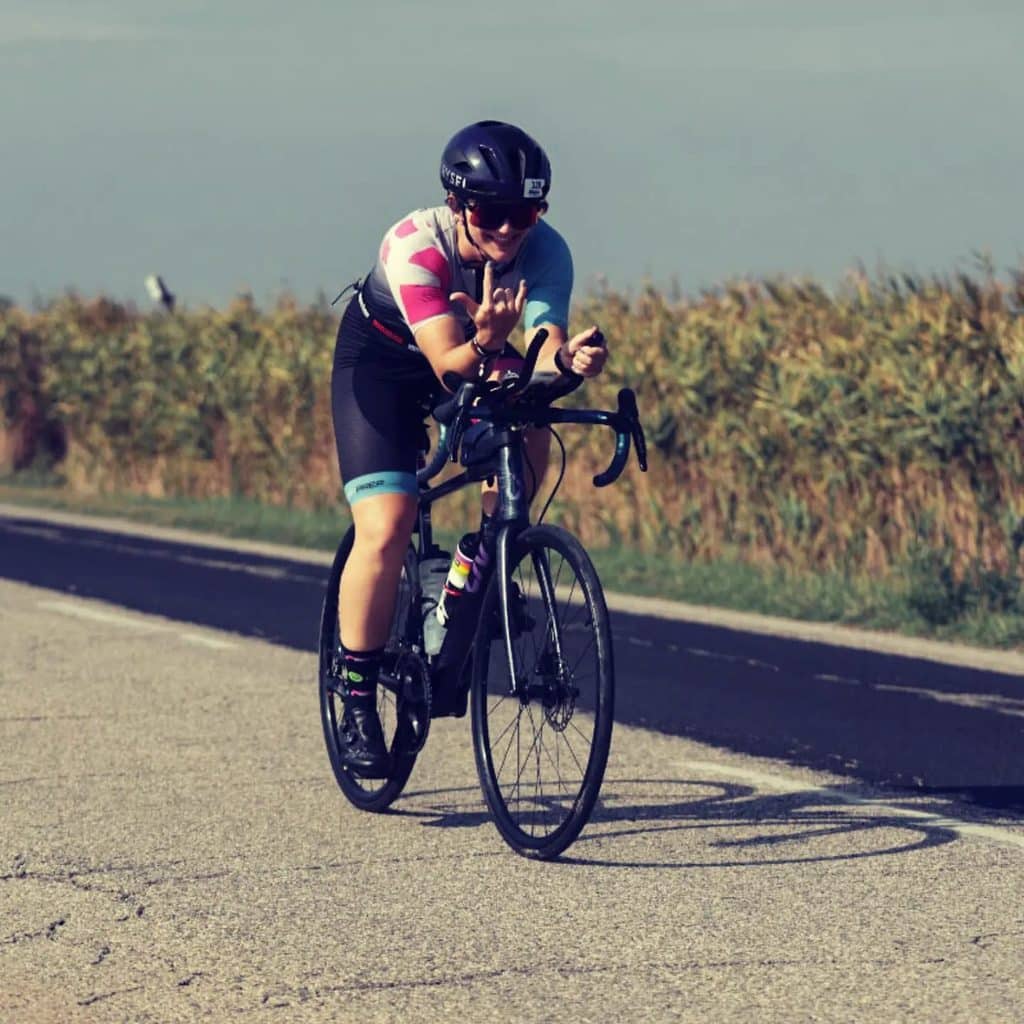
The IRONMAN Italy bike course is predominantly flat, making it a course where athletes can settle into position and maintain consistent power for long periods.
There is, however, one notable hill which is ridden twice.
Alicia described the climb as roughly 2km long, with several sections reaching around 13%. It’s very manageable, but certainly enough to break up an otherwise flat bike course.
The climb also passes through a particularly attractive section of town and is followed by an enjoyable descent.
Road quality was excellent. A significant proportion of the route uses motorway or dual-carriageway-style roads, which means there are relatively few interruptions or tight turns.
The trade-off is that the second lap can become slightly monotonous.
Congestion wasn’t a significant problem. Alicia did notice some drafting, but there was enough space to ride her own race and maintain the appropriate distance.
Alicia’s Bike Pacing
Alicia felt her pacing was good and never felt as though she was working particularly hard.
In hindsight, she believes she probably had the legs to ride a little faster. However, with the uncertainty surrounding her run preparation, the decision was made to protect the marathon rather than take unnecessary risks on the bike.
She did, however, enjoy overtaking plenty of men riding very expensive bikes along the way.
There was some rain during the middle of the day and a few sections with a noticeable headwind, although neither dominated the bike leg.
Looking back, the rain may actually have contributed to one important mistake. Because it disguised how warm the day was becoming, Alicia suspects she didn’t drink quite enough fluid.
IRONMAN Italy Bike Aid Stations
Aid stations were frequent. Roughly every other station provided solid nutrition including bananas, bars and gels, while the others concentrated on water and electrolytes.
Water was handed out in plastic bottles, so Alicia recommends considering a larger bottle that can be refilled. She saw several of the supplied bottles bouncing straight out of athletes’ bottle cages.
Racing a Flat, Fast Ironman?
Alicia’s controlled bike gave her the best chance on the run, and her swim showed what focused practice can do. These two plans are built for flat and rolling full distance courses, with pacing and fuelling practised through the build.
T2: Bike to Run
T2 was again smooth, although there was another reasonably long distance to cover while doing what Alicia described as the inevitable “little penguin run” in bike shoes.
IRONMAN Italy Run Course
The IRONMAN Italy marathon course is extremely flat.
Alicia’s first two or three kilometres felt fantastic — at which point she had to remind herself that, because of the disruption to her run preparation, the plan was to use a controlled run/walk strategy.
The marathon consists of four loops of approximately 10km. This works particularly well for spectators because supporters have multiple opportunities to see athletes throughout the race.
The route also passes restaurants and other busy areas where people were happy to encourage the athletes.
Unfortunately, Alicia’s marathon soon became a much tougher challenge than expected.
When the Marathon Became a Battle
Alicia developed stomach cramps relatively early in the run. Eventually, gels and food began making her feel sick.
For approximately 20km of the marathon she essentially stopped eating.
Small sips of Coke at the aid stations became one of the few things she could tolerate and the priority changed from running a particular pace to simply continuing to move forward.
There were some very dark moments.
At points Alicia was literally falling asleep while running. But by then the objective was straightforward: keep putting one foot in front of the other and get to the finish.
Run Aid Stations & Crowd Support
Run aid stations were positioned approximately every 2–3km, with gels and some salty snacks available alongside water and electrolytes.
There were also misting showers and volunteers offering to throw jugs of water over athletes to help with cooling.
One station did run out of non-caffeinated gels, which may be worth considering for athletes who rely on a particular type of race nutrition.
Crowd and volunteer support was excellent. Volunteers and spectators regularly read athletes’ names from their race bibs and offered personalised encouragement.
Numbers naturally reduced as it became darker, but Alicia felt the atmosphere remained positive throughout.
Becoming an Ironman
After everything that had happened during the marathon, seeing the red carpet brought one overwhelming emotion: relief.
Alicia had a group of her favourite people waiting at the finish. She doesn’t remember the moment particularly clearly herself, although the photographs apparently tell the story — she crossed the line with an enormous grin on her face.
Even with Alicia finishing at around 10pm, the finish area remained busy and lively, with music playing and plenty of people still there to cheer athletes home.
What Went Well, and What Would Alicia Change?
The swim was one of the clearest successes of the day and demonstrated how much progress Alicia had made through her swimming work.
She was also happy with the bike leg.
With hindsight, part of her wishes she’d ridden harder given that the marathon ultimately became difficult anyway — although that is much easier to conclude after the race than during it.
One possible explanation for the stomach problems is that Alicia began the run slightly dehydrated.
She had been eating flapjacks on the bike before switching to gels on the run. Combining a more concentrated carbohydrate source with insufficient water may have made absorption difficult and contributed to the GI problems.
If she raced IRONMAN Italy again, Alicia would arrive with a more specific time goal. She believes the course has the potential to be very fast.
There is also one very practical change she’d make before travelling: put an AirTag or similar tracker in the bike box so that if the bike disappears in transit, she can at least confirm whether she and the bike are in the same country.
Alicia’s IRONMAN Italy Race Ratings
Would Alicia Recommend IRONMAN Italy?
A fast, well-organised Ironman with relatively few surprises.
Alicia would recommend IRONMAN Italy, particularly to athletes looking for a course where they can concentrate on producing a fast performance.
There are some compromises if you’re looking for scenery and character throughout the entire race. The motorway section makes up a significant proportion of the bike course and can become monotonous, particularly on the second lap.
The run has considerably more character, particularly when it passes through the old town, and the spectator and volunteer support was a major positive.
Alicia’s overall IRONMAN Italy rating: 9/10.
Final Thoughts: Alicia’s First Ironman Finish
Alicia’s first Ironman wasn’t a race where everything went perfectly — and that’s precisely what makes the finish meaningful.
She arrived in Cervia after an interrupted run build and with uncertainty about what would happen when she attempted her first marathon.
She then produced a swim that reflected the enormous progress she’d made in the water and executed a controlled bike leg designed to give herself the best possible opportunity on the run.
When stomach problems turned the marathon into a battle and taking on nutrition became increasingly difficult, the race stopped being about pace and became about finding a way to continue moving forward.
That’s exactly what she did.
First Ironman completed — and an Ironman finish earned the hard way.
IRONMAN is a registered trademark of World Triathlon Corporation. Enduraprep is not affiliated with or endorsed by WTC.