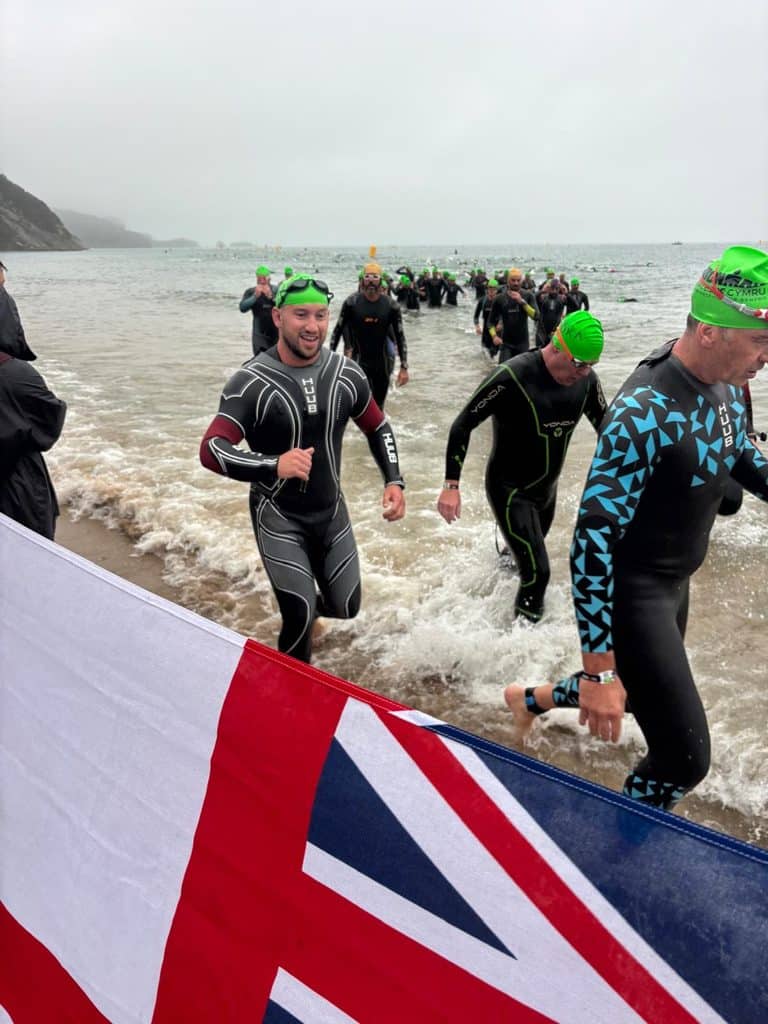
Ironman Wales has a reputation as one of the toughest Ironman races around. A sea swim in Tenby is followed by a relentlessly hilly bike course and a run through a town famous for the noise of its crowds.
Enduraprep athlete Deri White took it on in September 2026. It was his first ever triathlon, and he did it in the kind of weather Tenby occasionally produces: rain, fog and wet roads from start to finish.
Ironman Wales 2026: Race at a Glance
Finish and swim times are the official IRONMAN results. Bike and run splits are as reported by Deri.
Coach Cronk’s Introduction
Deri’s journey to Tenby was never going to be a conventional one.
He had been following my training programme on and off for several years while his work kept him away at sea for a large part of the time between signing up and racing. He postponed the race twice for work reasons, so when the start line finally came around, he wasn’t going to waste the chance.
What stands out in his report is how honest it is. He tells you what went well, including fuelling, preparation and an excellent support team. He also tells you exactly where time was lost and what he would change. That’s the kind of detail future Ironman Wales athletes can learn from.
Here’s Deri’s experience of racing Ironman Wales.
Arriving in Tenby & Pre-Race Logistics
Deri stayed overnight with friends who live locally. The drive was long, with plenty of stops to stretch, but the accommodation was easy and convenient.
His advice for future athletes: stay in the centre of Tenby if you can. If you can’t, stay within about 20 minutes of Tenby by normal driving, and allow 45 minutes to get there on race day.
Parking was busier than in previous years, with very long queues for the lesser-known Greenhill school car park. Deri’s support team used three vehicles with three drivers. One car dropped him and a driver near transition before parking, and the other two were positioned beyond certain road closures so supporters could walk out and then drive to other points on the course. He described that plan as working very well. The park and ride buses, by contrast, looked like a nightmare, with queues of more than an hour in the rain.
Registration & the Pre-Race Atmosphere
Registration was easy, made easier by staying nearby. Pre-race communications were good overall, although the wetsuit rules were confusing. Deri also noted that my Ironman Wales YouTube videos “almost made the IM race briefing video obsolete.”
The race pack was a little disappointing but functional, and the expo atmosphere was probably dampened by the weather. The volunteers were very helpful and the vibe before the race was “excellent, despite the wet weather.”
Watch: the Wales Bike Course, Explained
The two videos Deri used to learn the course before race day.
Part 1: the first 60km
Part 2: the Hard Loop
Tip for Armed Forces & Service Personnel
The Ex-Servicemen’s Club, opposite Five Arches and above the South Parade Post Office, was welcoming for a last-minute loo break before the swim. The Tenby Aces Tri-Team also uses it as a pre-race base. Deri was a Royal Navy serviceman, and the landlady kindly let him use the facilities.
Training & Readiness
Deri went into the race confident of finishing but unsure of how or in what time. His goal was simply to finish. He would have liked a time around 12:30 and believed he was capable of it, but he would have been reasonably happy with anywhere between 14 and 15 hours.
The training programme took a lot of the thinking out of it for a first-timer. His work meant he rarely completed a full week, but the programme was flexible enough, and the session notes clear enough, that he could usually hit the key sessions and the overall intent of the week. Completing even 60–70% of the programme left him confident of finishing, and wondering how much better he could have done with the full plan.
He had been deployed or at sea for about 70% of the three years between signing up and racing. In the last three months he was ashore in a reasonably undemanding job, which sped up his progress substantially.
Setbacks in the Build
- A US road trip at the wrong time. Six to four weeks before the race, Deri spent two weeks hiking at altitude in the USA, walking around eight hours a day under load with a heart rate of 150+ bpm. It was excellent endurance work, but it fell in the critical build phase, so he would do it much earlier next time.
- A sinking seat post. It had sunk gradually over his training, by 6cm in total, and the final week brought a soft tissue injury in his left knee. He tried to fix it the day before the race and was in pain swimming, cycling and running. Having postponed twice already, he wasn’t going to quit.
- The course recce. He rode the course a few months earlier with a local friend who had completed Ironman Wales several times. Next time he would do several recces and more intense sessions on the course to help with pace targeting.
Race Morning & the Swim Start
The support team looked after him brilliantly. They made sure he was fed carbohydrates the day before and drove him in on race morning, with a big bowl of overnight oats in the car. Finding a loo was critical, since the portaloos had no toilet paper, and he was glad he’d packed some in his T1 bag.
He didn’t find a suitable place or time to warm up, so he went into the swim having done nothing more than stand in the rain.
At the start he was nervous about the enormity of the day, and slightly disappointed that he only remembered some of the Welsh national anthem. He was also inspired by hearing it in that natural amphitheatre. The queue system to enter the water left him anxious and a little confused, and not really fired up.
The Swim
Target: 1:05 | Actual: 1:27:32
Deri’s word for the swim was “carnage.” With so many people swimming in one place, he couldn’t find enough room to settle into a rhythm. The spray made breathing stressful, and he lost his usual technique immediately. Normally he breathes to both sides every three or five strokes, but he was only breathing to one side and on every other breath.
About 10 to 15 minutes into the first loop, his wetsuit was pulled open. He’s unsure whether it was a malfunction, a poor fit or another swimmer catching the zip pull. The suit filled with water, especially the right arm, which became heavier to lift, and it lost its hydrodynamic efficiency and chafed his neck badly. His support team were easy to find at the front of the beach and fixed the zip for the second loop, but he was more fatigued than usual for the distance and the second loop was slower.
There was a definite swell but no real sea state, and visibility was fine with just a little sea fog. The markers were obvious. Congestion was terrible, with lots of people swimming over or hitting each other, Deri included. He deliberately picked less efficient lines and changed his pace to find clear water.
Swim Lessons
- Check the tide, or a tidal atlas, before the race.
- Get the wetsuit rules straight in advance. Deri would have swum without a wetsuit, or invested in a lighter one, if he’d had the choice.
- Check the zip and the fit before race day.
- Think about where you start. The area for 1h15m swimmers was big enough for about 60 people, yet hundreds had that time in mind.
Transition 1
T1 could have been smoother, as Deri admits he wasn’t in a high-efficiency mindset. He crammed in half a Real Meal bar, which was excellent fuel, and resigned himself to being wet for the rest of the day. My videos and a good recce the day before made it much less daunting, and it was pretty straightforward.
The Bike
Target: 6:30 | Actual: 7:15
The weather was, in Deri’s words, “utterly foul.” Drizzle, rain and fog lasted all day, making most descents dangerous and causing wheel spin on the Wiseman’s Bridge climb. He saw the aftermath of a lot of wipeouts and crashes. Surfaces were very wet but mostly good, with a few minor potholes and some agricultural gravel.
He spent the first 30km cold and wet, contemplating riding headfirst into a hedge or a ditch to call it a day. It got better after that. The highs included seeing his support team in random places about half a dozen times as they traipsed all over the county. Heartbreak Hill was phenomenal the first time and felt like a breeze, but much less fun the second time with a sunk seat post.
Where the Time Went
- Fuelling stops: two stops of about two minutes each to pour premade fuel powder into bottles.
- Over-hydration: four toilet stops of two to three minutes each. Deri’s fix for next time is one bottle of powder with no water and one with water, to solve both this and the stops above.
- The seat post: it had sunk again by the first time through Narberth, so he stopped in Saundersfoot for four to five minutes to adjust it. It dropped again slightly before the second Narberth, but with only a few miles left he kept going. The lower seat slowed his pace and made the knee pain worse.
In total, those stops cost somewhere around 15–20 minutes by Deri’s own estimates. He also believes he took it too easy on the bike overall, daunted by the distance and the weather. Balancing out the climbs with the descents was much harder in the wet. He noted that being in the drops instantly improved his pace by about 2–3mph, so he would look at tri-bars next time.
Fuelling was excellent, with no issues. Drafting was minimal, with just a few teams or pairs using each other, and the atmosphere was otherwise amicable.
Transition 2
T2 was “a bit of a daze.” Deri took far longer than necessary, had yet another toilet stop and lost his bike computer somewhere, which IRONMAN staff found and are posting to him. He ran out of things to do and sat there. The garlic bread and hummus sandwiches were delightful.
The Run
Target: 4:00 | Actual: 4:36
The knee was very painful to begin with, but settled to “just a bit of pain” after the first few kilometres and some ibuprofen.
Deri’s target paces were 11 min/mile on the ascents, 9:30 on the flat and 8:00 on the descents. It turned out that there are no flat sections at all, because everything at least undulates. He went soft on the 11 min/mile uphill target, easing off to 12+, which he regrets. He also couldn’t make time back on the descents, because it was so wet he couldn’t trust his knackered legs to let go as he normally would.
The cobbles weren’t as bad as he’d imagined but were very slippery in the conditions. He found Tenby town centre the worst section, because the inclines are unexpectedly steep and the tight corners meant constant stop-start running. The crowd support was brilliant. He couldn’t believe how many people were out in that weather by choice, many of whom had been outside since dawn. Later in the evening, some of the crowd near a couple of the pubs became more annoying.
The feed stations were very well placed and very frequent, so much so that he thinks he overindulged and loitered in them too long.
The Volunteer Who Dried His Feet
On the second loop Deri was completely drenched and suffering from the early stages of trench foot and blisters. He stopped at the Run Personal Needs Station to apply Compeed, and one of the volunteers dried and cleaned his feet for him. The Compeed wouldn’t stick because everything was so wet, so the volunteer applied chafe balm instead and sent him on his way. Once the rain eased, Deri put on dry spare socks, which made a world of difference to his morale and the blisters.
He was baffled, impressed and thankful at how helpful the volunteers were, especially that one.
The Finish
Deri crossed the line in an official 13:46:58. It felt awkward, because he finished in the same few seconds as an emotional father-and-son team and felt guilty for gatecrashing. His body was confused by the sudden cessation of movement.
He also felt he could have gone on significantly longer, which made him think he hadn’t spent what he had in the tank wisely. He was enjoying the crowd and camaraderie on the course, so the finish was a blur and he was almost sad to be done.
After the finish line, the area felt like the aftermath of a natural disaster, with a lot of exhausted, soaking wet people. It was still very good. The food was good, although he was less impressed by the beer. He nearly forgot his bike in the daze, but his support team had positioned all the cars in the right places, which made leaving easy. The park and ride queues looked appalling in the rain.
Post-Race Reflection
What Went Well
- Pre-race admin and preparation
- Fuelling, which was spot on
- Feeling strong and enjoying most of the day, apart from the weather
What Didn’t Go to Plan
- The swim
- The weather
- Not pushing hard enough to hit the targets he had set
What He’d Do Differently Next Time
- Push harder
- Train harder and more consistently
- Practise triathlons at challenging distances
Deri’s summary: a first ever triathlon and a first-time finish in a fair time. He loved it but felt he had more to give. He treated it too much like a big training and experience day instead of a race, mostly because he had never done the bike and run distances before, let alone together. The knee pain and the weather dampened both body and spirit, and a lot of learning occurred.
Racing Wales for the First Time?
Deri finished on 60–70% of a plan. These two Tenby-specific plans are built around the course he rode, with pacing, fuelling and course videos built in.
The Course & Organisation
Swim
The course was easy to navigate. Deri thought the pre-start queuing system was unfit for purpose and that IRONMAN should rethink crowd control before the lineup, because a cattle-pen or corral system would be far more effective than a long fenced queue. There were plenty of kayakers and small boats for safety, though in the melee he didn’t think kayakers have much use as communicators, unless there’s an active rescue.
Bike
Traffic management and safety were very good, helped by the fact that the whole of Pembrokeshire seems to buy in to the weekend. Safety signs were helpful and mostly in the right places for dangerous corners and descents, but crowd members signalling were even more useful, especially to indicate wipeouts. The feed stations were very good.
Run
Navigation was easy, and it’s impossible to get lost. The tight corners that break your rhythm are punishing. The feed stations were very good with caring volunteers, and there were almost too many. Next time Deri would resist the temptation and pass them by more often. The atmosphere from volunteers and spectators was fantastic, with the supporters’ commitment “mind-blowing and overwhelming in a good way,” apart from a few leery drunks in the centre of town.
Deri’s Ratings
| Category | Deri’s performance / own organisation | The race experience |
|---|---|---|
| Swim | 5 | 7.5 |
| Bike | 6.5 | 9 (7 in the weather) |
| Run | 7 | 8 |
| Organisation | 8 (own and support team) | 9 |
| Logistics | 9 (own and support team) | 8 |
| Volunteers | 9.5 | |
| Overall race | 8 / 10 | |
Would He Recommend Ironman Wales?
Absolutely. Deri believes any normal person willing to put some work in beforehand, and then persevere on the day, can do it.
He described loving being in his own little world while witnessing everyone else in theirs, like individual bubbles that merge for a few moments or sections of the race, so that you share that small world with those around you. In his words: “Everyone running their own race, but all doing it together.”
Deri’s Top Tips for Ironman Wales
- Don’t underestimate the short, undulating hills on the run. The long hills are obvious, but it’s the little ones that get you.
- Get accommodation in town, or have a support team to drive you. Secondary vehicles are an absolute force multiplier if you can organise them.
- Stay central in Tenby, or allow plenty of time for parking and the park and ride.
- Check the wetsuit rules, the zip and the fit before race day, and check the tide.
- Ride the course beforehand, ideally more than once, with some race-pace sessions on it.
- Check your seat post and bike setup well before the final week.
- Keep your own fuel and toilet paper in your T1 bag, just in case.
Training for Ironman Wales?
Enduraprep coaching and training plans are built around your goals, your experience and real life, including the demands of the Wales course.
Questions? Email coachcronk@enduraprep.com for a free consultation.
IRONMAN is a registered trademark of World Triathlon Corporation. Enduraprep is not affiliated with or endorsed by WTC.