Adam arrived at the 2026 Mumbles Olympic Triathlon with what seemed like a challenging but realistic target: finish inside the top five of his new 40–49 age group.
Six weeks earlier he had completed IRONMAN Leeds. Training volume had subsequently dropped, illness had interrupted the final weeks of preparation, and Mumbles was intended primarily as an enjoyable final race of his first triathlon season.
Instead, a strong swim, controlled bike and progressively faster 10K run produced something he hadn’t expected: first place in his age group.
Mumbles Olympic Triathlon Race Details
“I went in hoping for a top-five age-group finish. I left having won it.”
Pre-Race Goals
Adam’s main objective was a top-five finish in the 40–49 age group. A finish somewhere between 2:40 and 2:50 felt like a good target range.
There was also some unfinished business from his previous Olympic-distance race, where mechanical problems on the bike had prevented the result from reflecting what he felt capable of.
Mumbles was the final race of the season, but it wasn’t an A-race or even a B-race. The plan was simply to race well, enjoy the day, collect another medal and finish his first season in triathlon on a high.
What happened was considerably better than expected.
Travel & Race Logistics
Adam travelled to Mumbles with Holly and the children and stayed in an Airbnb close to the event.
With Mumbles only around an hour from home, the race was easy to turn into a family weekend rather than a major logistical exercise.
That was one of the attractions of returning to Olympic-distance racing. With the race lasting only a few hours, the family could watch without committing to the all-day experience that comes with a full-distance Ironman.
They travelled down on Friday. Traffic into Mumbles was busy, but otherwise the journey was straightforward. The Airbnb was easy to find, parking around the venue was simple and the entire weekend involved very little logistical stress.
Registration & Pre-Race Organisation
Registration was held in the yacht club directly opposite the event area and Adam found the process extremely smooth.
Around a week before the race, the organisers sent athletes a detailed race pack by email. There was also a YouTube race briefing covering the important information. Between the written pack and video briefing, Adam felt he knew exactly what was required before arriving.
The expo itself was relatively small, although that wasn’t a significant issue for an event of this size.
The volunteers made a particularly good impression. They were friendly, knowledgeable and genuinely keen to help, while the event maintained a relaxed atmosphere with enough pre-race buzz to make it feel like race weekend.
Training & Readiness
Adam felt well prepared, although the final build wasn’t what he would normally describe as perfect.
He had been ill around two weeks before Mumbles and had completed IRONMAN Leeds only six weeks earlier. As a result, training volume was substantially lower than it had been during the Ironman build.
In hindsight, that reduction may have been exactly what he needed.
Months of high-volume Ironman preparation meant the endurance and fitness were already established. The reduction in training load allowed much of the accumulated fatigue to disappear.
Adam didn’t arrive feeling undertrained. He arrived feeling rested, physically good and ready to race.
Race Morning
Race morning began at around 4:30am with Adam’s usual high-carbohydrate breakfast: oats with a little Skyr followed by two bagels.
He then took his time getting to the venue and met a friend who was also racing. Because it was one of his friend’s first triathlons, Adam spent some time helping him with his preparation.
That probably helped Adam as much as his friend. Having somebody else’s race to think about stopped him overanalysing his own.
Transition setup was straightforward. The bike was working, all the equipment was where it needed to be and there were no last-minute problems.
Physically he felt good, mentally he felt relaxed and by the time transition closed he was ready to race.
Mumbles Olympic Triathlon Swim
The race began with a 1.5km sea swim in Mumbles Bay.
The tide was beginning to go out, the water temperature was around 18°C and there was some chop — conditions Adam actually enjoyed.
He deliberately positioned himself fairly far forward after talking to several athletes expecting to swim around 30 minutes. That seemed like the right group to start alongside, although Adam hoped he might be able to swim slightly faster.
The Olympic swim consisted of two laps. The first went well despite some congestion. On lap two, Adam began catching slower sprint and Olympic swimmers, making the areas around the turn buoys considerably busier.
It wasn’t his best ever swim, but it was a solid one. Adam exited the water around the top 20 of roughly 190 Olympic-distance swimmers and, more importantly, felt good heading towards the bike.
Swim Organisation
Adam rated the swim organisation very highly.
The buoy layout was clearly visible from the pier and the direction of the course was changed from clockwise to anti-clockwise because of the tide and current. The organisers communicated the change clearly before the start.
The two-lap course also included an Australian exit, which Adam particularly enjoyed.
There were plenty of lifeguards and safety personnel on the water and at no point did he feel unsafe.
T1 — Swim to Bike
T1 was, in Adam’s words, “silky smooth.”
The wetsuit came off easily, nothing was forgotten and he moved through transition without any problems.
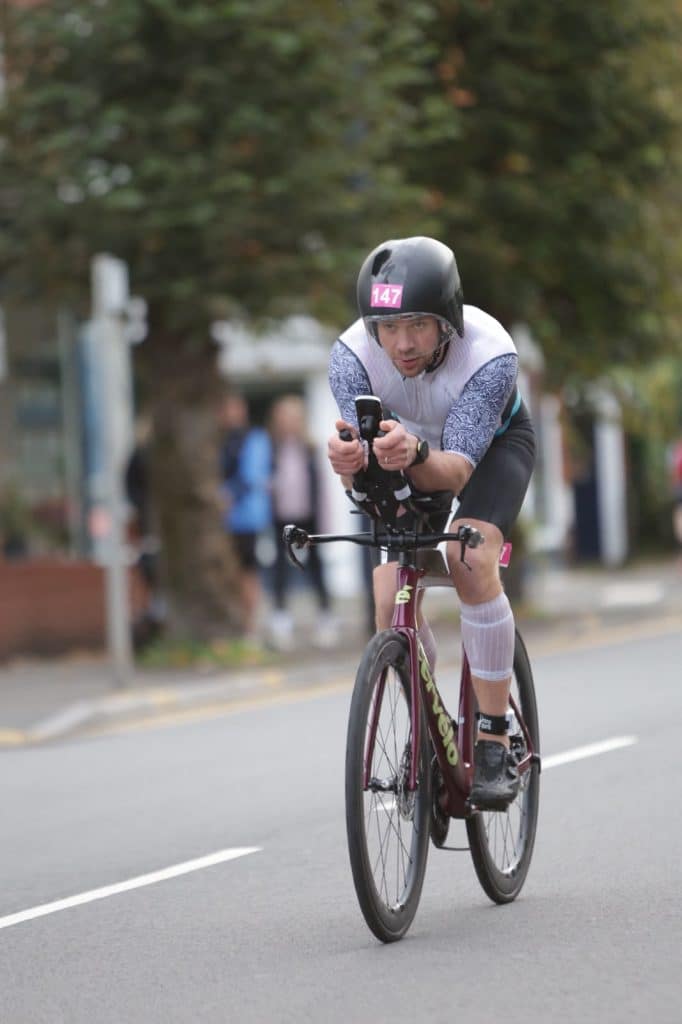
There was one minor aerodynamic mishap that he only discovered when looking at the race photographs afterwards. His aero calf covers had somehow become rolled up while dealing with the wetsuit.
Adam was so focused on racing that he never noticed and completed the entire bike leg with them sitting in completely the wrong position.
More importantly, as he left T1 he noticed that only around nine or ten bikes had already disappeared from transition.
That was the first indication that he was having a very good race.
Mumbles Olympic Triathlon Bike Course
The bike was the discipline Adam had been most excited about.
He had a new TT bike, TT helmet and new aerodynamic position, and Mumbles provided the first opportunity to race the complete setup properly.
The official Olympic course is approximately 42km and heads from Mumbles onto the Gower Peninsula.
Adam already knew much of the route from a previous Swansea Half course recce, so there were few surprises. The climbs were manageable, the descents straightforward and the road surfaces generally good.
Compared with many of his normal South Wales training roads, nothing felt particularly intimidating.
Bike Pacing & Nutrition
Adam had a clear power plan and followed it closely.
His legs felt excellent and he was able to maintain the aero position for almost the entire ride apart from the climbs.
Nutrition was deliberately simple. He carried around 80g of carbohydrate in his bottle, which was sufficient for an Olympic-distance bike leg.
Conditions were good and there was very little noticeable wind.
The main frustration was traffic. During the final 10km, Adam began catching slower athletes from the sprint race. Cars were understandably waiting patiently behind those riders, but this created queues that also trapped some of the faster Olympic-distance athletes.
Despite that interruption, the bike went extremely well.
Adam steadily overtook other Olympic athletes and returned to T2 with what appeared to be only six to eight bikes already on the racks.
He didn’t know which age groups those athletes belonged to, but by then it was clear that his race was developing into something considerably better than he’d expected.
Stepping Up to Long-Course Racing?
Adam’s Olympic win came off a full Ironman build, and his next goals are IRONMAN Lanzarote and IRONMAN Wales. If you’re building towards a full-distance race, these plans are structured around the same approach: controlled pacing, power-based bike work and a run that finishes strong.
T2 — Bike to Run
T2 was smooth again.
Adam was particularly pleased that the new TT position had remained comfortable and sustainable throughout the bike and that his legs still felt strong.
He took a quick gel, drank some water, changed into his running shoes and headed straight onto the run course.
Mumbles Olympic Triathlon Run
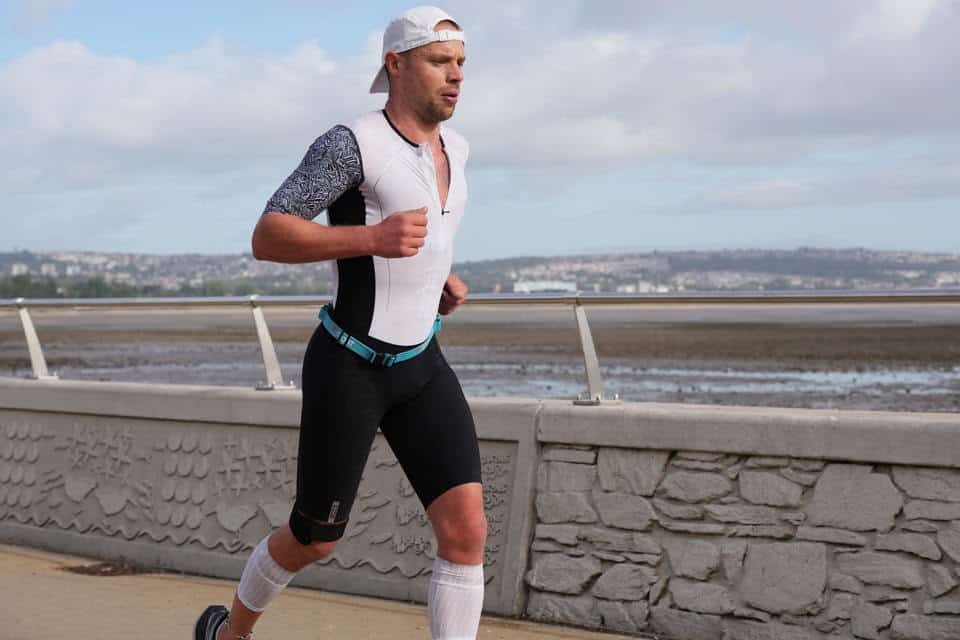
The run is a flat 10km coastal course along Mumbles, completed as two 5km out-and-back laps.
Adam’s legs felt surprisingly good immediately off the bike.
Having completed a full-distance Ironman only six weeks earlier may also have changed his perception of the challenge. Compared with an Ironman marathon, a 10K suddenly felt very manageable.
A Progressive 10K
The pacing plan was to start at around 4:30/km and progressively increase the effort.
Adam followed that plan almost exactly.
He began at roughly sweet-spot effort, moved towards threshold as the run developed and finished the final section at something approaching VO2-max intensity.
Several athletes ran past him early. Rather than responding immediately, Adam felt some of them had probably started too hard and allowed them to go while sticking to his own pacing strategy.
As the kilometres accumulated, he began catching many of them again.
At around 8km Adam realised he still had plenty left and increased the pace to approximately 4:00/km.
Looking back, he believes that final acceleration could probably have started a kilometre or two earlier. During the race, however, he was conscious of protecting the strong position he’d already established.
There was no dramatic high or low. It was simply a controlled run that became progressively harder exactly as planned.
Crowd support was excellent, Holly and the children were there cheering, and the objective remained simple: continue increasing the effort rather than allowing the pace to drift backwards.
Finding Out He’d Won His Age Group
With around one kilometre remaining, Adam was running at approximately 4:00/km. Realising there were probably only another four minutes of racing left gave him another boost and he tried to squeeze out still more speed.
By then he was increasingly curious about the result.
He knew he’d raced strongly. He knew the finishing time was going to be good. And from the number of bikes in transition and the athletes he’d seen around him, he suspected he might be close to the front of his age group.
Adam crossed the line, collected his medal and took a couple of minutes to get his breath back after pushing the final section hard.
He then found Holly and the family, gave everyone a hug and checked the results online.
First in the 40–49 age group.
Adam had arrived hoping to finish inside the top five.
He had never expected to win.
It was a brilliant result and an especially satisfying way to finish his first season in triathlon.
What Went Well?
Perhaps the most interesting part of Adam’s performance was that there wasn’t one extraordinary discipline.
The swim wasn’t extraordinary. The bike wasn’t extraordinary. The run wasn’t extraordinary.
Instead, he put together three very well-executed elements of a triathlon.
Very little went wrong. Each discipline was paced sensibly, he remained in control throughout and the result came from putting together a complete race from start to finish.
Adam was particularly surprised by how strong he felt running off the bike.
What Would Adam Change?
As with almost any successful race, hindsight creates opportunities to find more time.
Adam believes he could probably have pushed slightly harder on the bike and started increasing the run pace a little earlier.
But that has to be balanced against the decisions being made during the race.
He was protecting a strong position and making sure he didn’t blow up. Finishing with something left isn’t necessarily a mistake when the result is an age-group victory.
What the Result Meant
Winning his age group in the final race of his first season was a result Adam was understandably delighted with.
He also credits a significant part of his progression to having personalised coaching throughout the season.
“A huge part of the progress has come from having a coach who knows me personally. Cronk has been able to rein me in when I have wanted to push harder than I should in training, while giving me the structure and guidance I needed throughout the season. I genuinely do not think I would have achieved what I have this year without that coaching.”
The result also changed Adam’s view of Olympic-distance racing.
His major goals remain long-course events, with IRONMAN Lanzarote and IRONMAN Wales on the horizon, but he enjoyed the shorter format enormously.
An Olympic-distance race doesn’t consume an entire day, involves far less logistical burden and gives athletes the opportunity to simply turn up and race hard.
Adam now intends to include more Olympic-distance events in future seasons and is even considering making a series such as the Welsh Triathlon Super Series a future focus.
Mumbles Triathlon Course & Race Organisation
Overall, Adam was extremely impressed with the organisation.
The swim was clearly marked, changes caused by the tide and current were communicated well and there were plenty of safety personnel in the water.
Bike signage was good and the course itself was easy to follow. The main weakness was the interaction with normal traffic, particularly when faster Olympic athletes caught slower riders from the sprint event.
Adam felt that additional closed-road sections or greater separation between the sprint and Olympic routes would improve the bike experience considerably.
The run was simple and effective: a flat coastal out-and-back completed twice, with very little opportunity to become confused.
The finish area was busy and atmospheric, with music playing and an announcer calling athletes home.
There wasn’t a dedicated recovery area, although Adam didn’t feel one was particularly necessary for an Olympic-distance event.
There was also no separate age-group podium ceremony on the day — something worth knowing if you’re fortunate enough to win your category.
Adam’s Mumbles Olympic Triathlon Ratings
Would Adam Recommend Mumbles Olympic Triathlon?
A well-organised local race with an excellent sea swim and straightforward logistics.
Adam particularly enjoyed the swim. The tide, current and slightly choppy conditions gave it character without making the course feel unsafe.
The bike and run courses were perfectly suitable for racing hard, although traffic on the bike reduced his overall rating of that discipline.
For athletes living in South Wales, Mumbles is particularly easy to recommend. It is straightforward to organise, doesn’t require an entire weekend of complicated logistics and works extremely well as a family race.
It’s also accessible to a broad range of athletes. The distances are manageable for newer triathletes, while more experienced athletes can race aggressively and chase a competitive result.
Adam’s overall Mumbles Olympic Triathlon rating: 7.5/10.
Tips for Racing Mumbles Olympic Triathlon
Listen carefully to the final swim briefing. The direction can change according to the tide and current, so don’t assume the course will be identical to what you’ve previously seen.
Expect congestion around the swim buoys. Faster Olympic swimmers may begin catching athletes from other waves during the second lap.
Be prepared for traffic on the bike. The course itself isn’t especially difficult, but vehicles can affect your pace once the different race fields begin overlapping.
Keep Olympic-distance nutrition simple. Adam carried his own bottle containing around 80g of carbohydrate and didn’t need additional nutrition on the bike.
Use the flat run intelligently. A controlled opening allowed Adam to progressively increase his effort and finish the final kilometres strongly.
Stay close to the venue if possible. It makes an already straightforward event even easier and helps Mumbles work particularly well as a family race weekend.
Final Thoughts — An Age-Group Win to End the Season
Adam’s Mumbles result is a good example of why a successful triathlon doesn’t necessarily require one spectacular individual split.
He arrived rested after a long Ironman season, positioned himself intelligently in the swim, followed his power plan on the bike and resisted the temptation to chase runners who started the 10K too aggressively.
When the opportunity appeared late in the run, he still had enough left to increase the pace towards 4:00/km and finish strongly.
Three controlled disciplines added up to something better than Adam had expected when he arrived in Mumbles.
Top-five target. First place in the 40–49 age group.